Globant AI Team Lead 2026

Saudi Tourism Authority: Noura for visitors and an AI assistant for staff

Led the AI engineering for two Saudi Tourism Authority assistants on one LangGraph agent: Noura for visitors and a staff assistant, in Arabic and English.

See the architecture
Role
Led the AI engineering (AI Team Lead) Full-time, Remote
Company
Globant for the Saudi Tourism Authority (STA)
When
Apr 2026 – Present 7 mos
Where
Remote, from Cairo
Stack
  • LangGraph
  • Python
  • FastAPI
  • RAG
  • LLM evaluation
  • React
  • TypeScript
serving both assistants
1 agent
typed, all called by that one agent
96 tools
of them visible to visitors
27
Fig. 1 sta-tourism-assistants · architecture
Saudi Tourism Authority assistants: one agent for visitors and staffArchitecture diagram. Two audiences come in: visitors, who use Noura in Arabic or English, and the authority's staff, who use the staff assistant. Both pass through an audience gate, which decides which tools and which knowledge the session may use, so a visitor never reaches staff tools or data. The gate hands the request to one LangGraph agent. The agent calls typed tools that return cards: 96 tools, 27 of them visible to visitors. Look-up tools (destinations and events, visas and weather) are called directly. Tools that change something (itineraries, and staff requests such as meeting rooms, leave and office coffee orders) are reached only through human approval: each action waits for the user's approval before it runs. The agent also calls an LLM and retrieval, which answers from the authority's own documents and tourism content and shows the sources. Evaluation checks answer quality and retrieval in the background.96 TOOLS · 27 FOR VISITORSVisitorsNoura · Arabic · EnglishStaffstaff assistantAudience gatetools · knowledge1Evaluationanswers · retrieval6One agentLangGraph2Human approvalbefore any action4Destinations & eventsVisas & weatherItinerariesStaff requestsLLMRetrievalwith sources5Authority contentdocuments · tourism3orchestratorretrieval · datamodel · LLMevaluationguard · safetyservice · infrastoreexternalrequestbatch · background1note
Saudi Tourism Authority assistants: one agent for visitors and staffArchitecture diagram. Two audiences come in: visitors, who use Noura in Arabic or English, and the authority's staff, who use the staff assistant. Both pass through an audience gate, which decides which tools and which knowledge the session may use, so a visitor never reaches staff tools or data. The gate hands the request to one LangGraph agent. The agent calls typed tools that return cards: 96 tools, 27 of them visible to visitors. Look-up tools (destinations and events, visas and weather) are called directly. Tools that change something (itineraries, and staff requests such as meeting rooms, leave and office coffee orders) are reached only through human approval: each action waits for the user's approval before it runs. The agent also calls an LLM and retrieval, which answers from the authority's own documents and tourism content and shows the sources. Evaluation checks answer quality and retrieval in the background.96 TOOLS · 27 FOR VISITORSVisitorsNouraArabic · EnglishStaffstaff assistantinternalAudience gatetools · knowledge per audience1One agentLangGraph2Evaluationquality6Human approvalbefore any action4Destinations & eventsVisas & weatherItinerariesStaff requestsLLMRetrievalwith sources5Authority contentdocuments · tourism3orchestratorretrieval · datamodel · LLMevaluationguard · safetyservice · infrastoreexternalrequestbatch · background1note

Figure 1 Two assistants for the Saudi Tourism Authority (STA) run on one LangGraph agent: Noura, for visitors in Arabic and English, and an internal staff assistant. An audience gate sets which tools and knowledge each session may use; typed tools return cards, every action waits for the user's approval, and answers show their sources. Diagrams show the components named in public descriptions of the work. They are simplified, not complete system maps.

  1. Audience gate. Decides which tools and which knowledge each session may use, so a visitor never reaches staff tools or data.
  2. One agent. A single LangGraph agent serves both Noura and the staff assistant, and works by calling tools.
  3. Typed tools. 96 tools, 27 of them visible to visitors, each returning a card: destinations and events, visas, weather, itineraries, and staff requests such as meeting rooms, leave and office coffee orders.
  4. Human approval. Every action that changes something, such as booking a room, placing an order, requesting leave or building an itinerary, waits for the user's approval before it runs.
  5. Retrieval with sources. Answers come from the authority's own documents and tourism content, and show their sources.
  6. Evaluation. Answer quality and retrieval are evaluated in the background.
Text description of the diagram

Architecture diagram. Two audiences come in: visitors, who use Noura in Arabic or English, and the authority's staff, who use the staff assistant. Both pass through an audience gate, which decides which tools and which knowledge the session may use, so a visitor never reaches staff tools or data. The gate hands the request to one LangGraph agent. The agent calls typed tools that return cards: 96 tools, 27 of them visible to visitors. Look-up tools (destinations and events, visas and weather) are called directly. Tools that change something (itineraries, and staff requests such as meeting rooms, leave and office coffee orders) are reached only through human approval: each action waits for the user's approval before it runs. The agent also calls an LLM and retrieval, which answers from the authority's own documents and tourism content and shows the sources. Evaluation checks answer quality and retrieval in the background.

On this page The problem
01

The problem

The Saudi Tourism Authority wanted two assistants: Noura, a public travel assistant for visitors, and an internal assistant for its staff. Both had to answer from the authority's own content, in Arabic and English, and a visitor could never reach staff tools or data.

02

Approach

  1. Tools that answer with cards: destinations, events, visas, weather and trip plans for visitors; meeting rooms, leave and office requests for staff.
  2. Answers grounded in the authority's own documents and tourism content, with their sources shown.
  3. A person approves every action: booking a room, placing an order or building an itinerary waits for the user's yes.
  4. Arabic and English throughout, right to left and left to right, on desktop and phone.
  5. Answer quality and retrieval measured by evaluations, not assumed.
03

Screens

Screens from the apps, with personal data removed.

Noura, for visitors

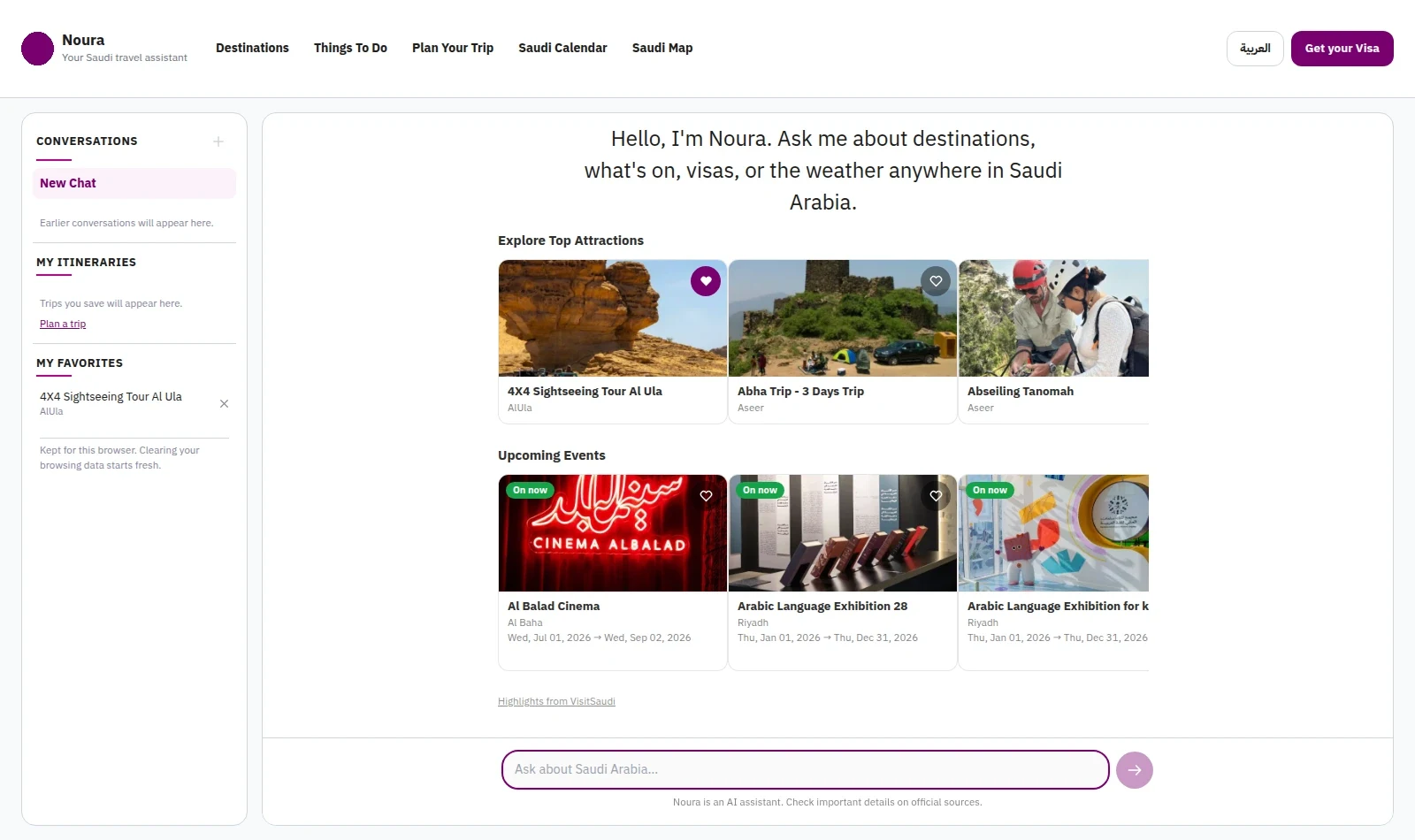
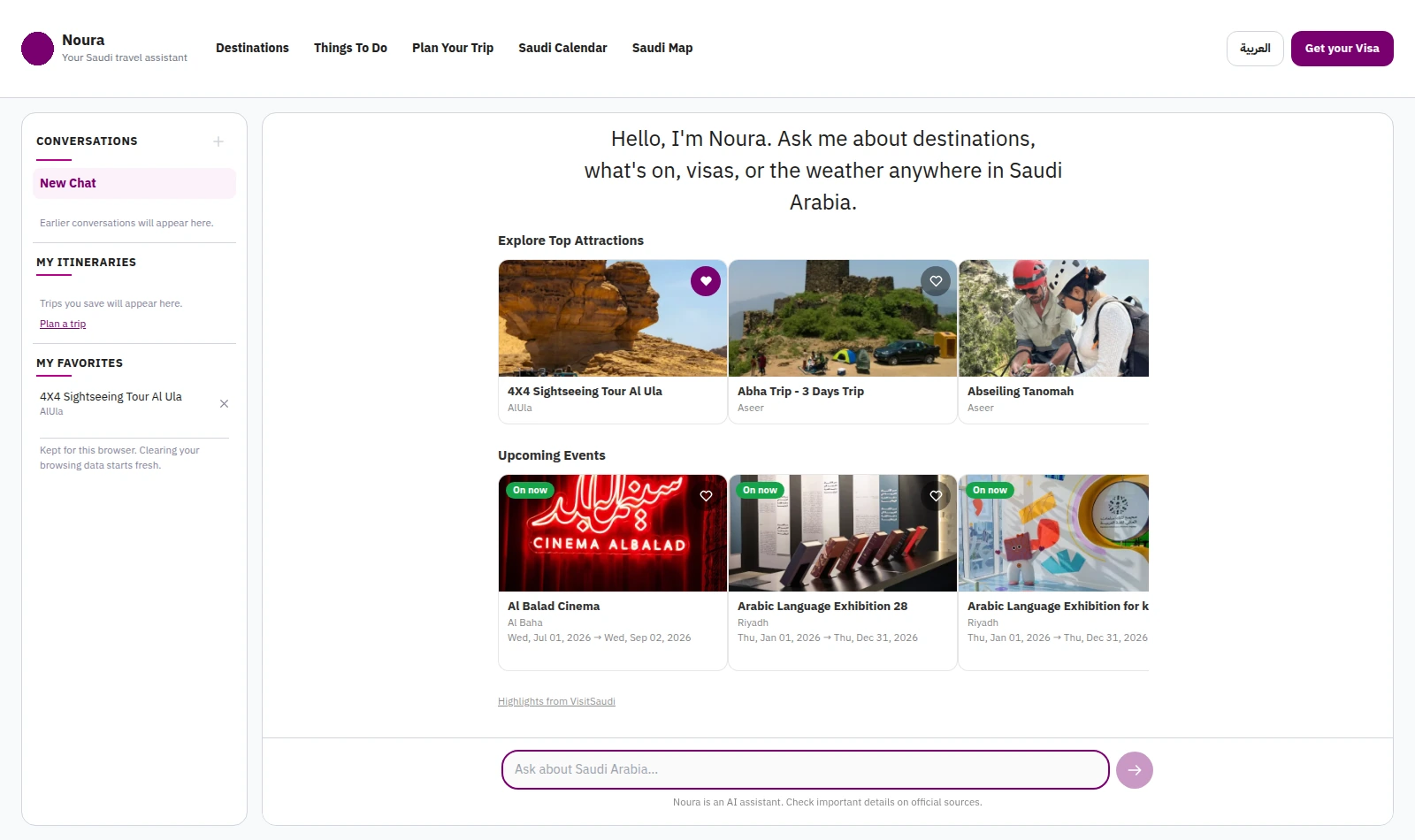
  • Noura's home screen in English
    Noura's home screen: top attractions and live events from Visit Saudi, with saved favourites.
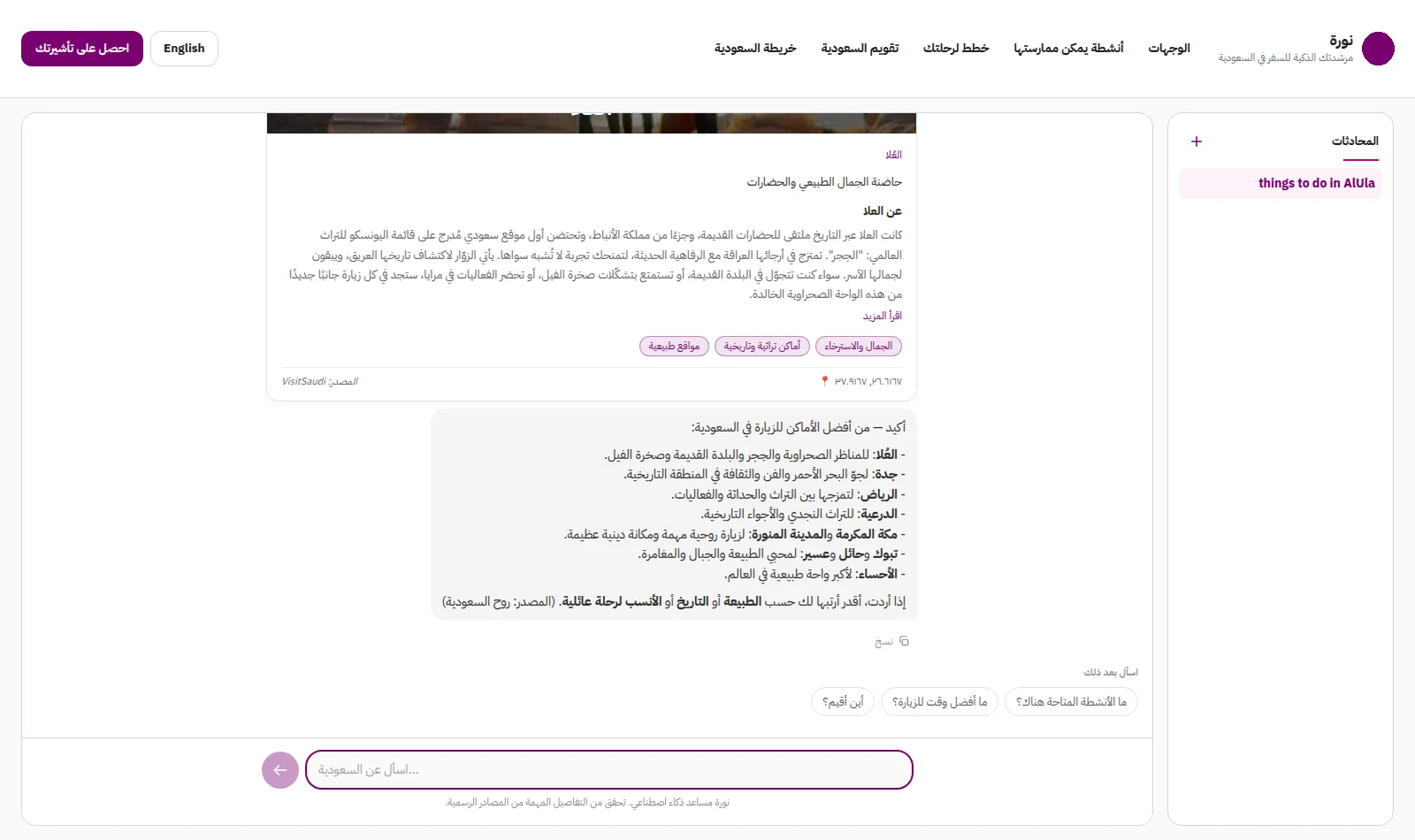
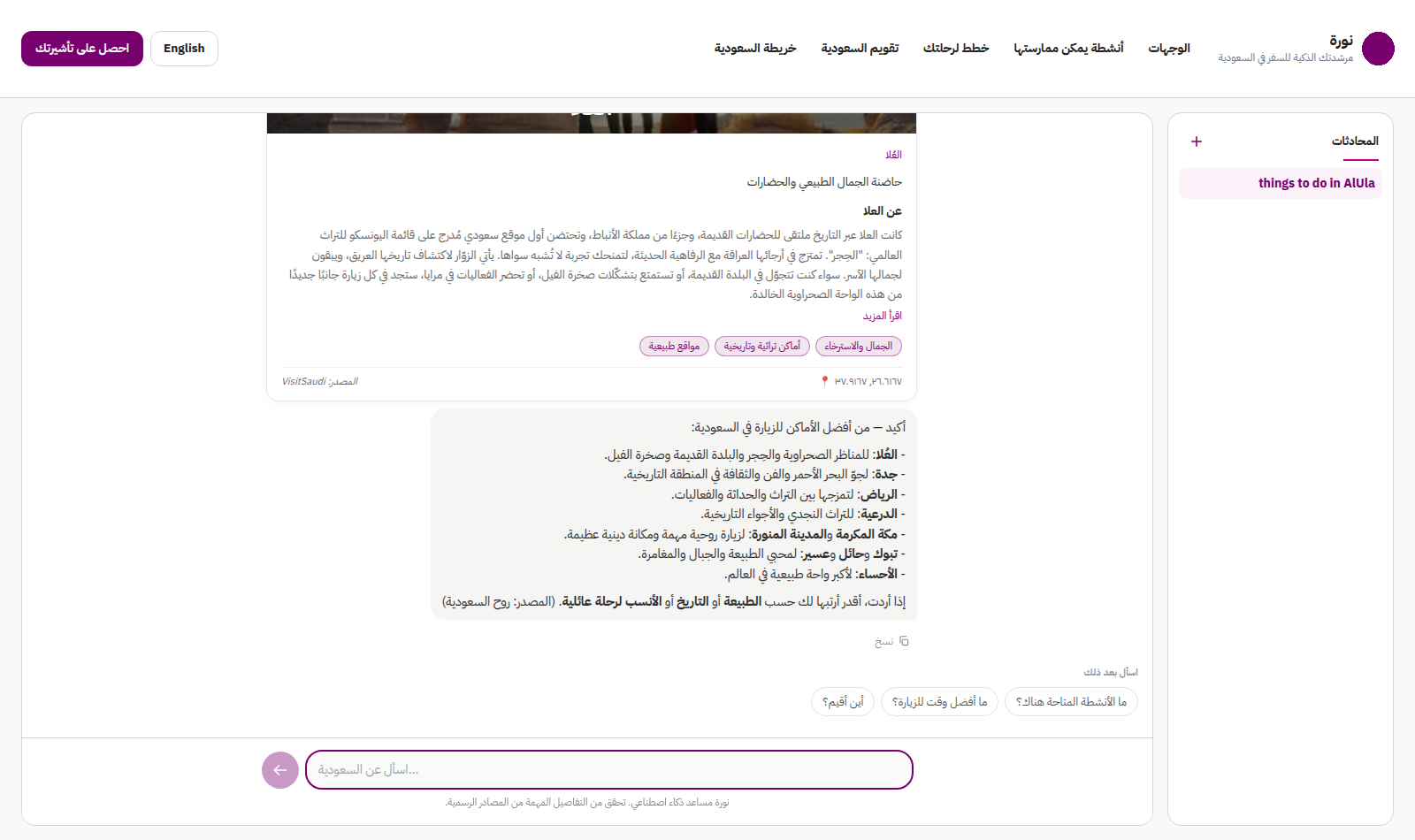
  • Noura answering in Arabic, right to left
    Noura answering in Arabic, right to left: a destination card for AlUla and a sourced summary.
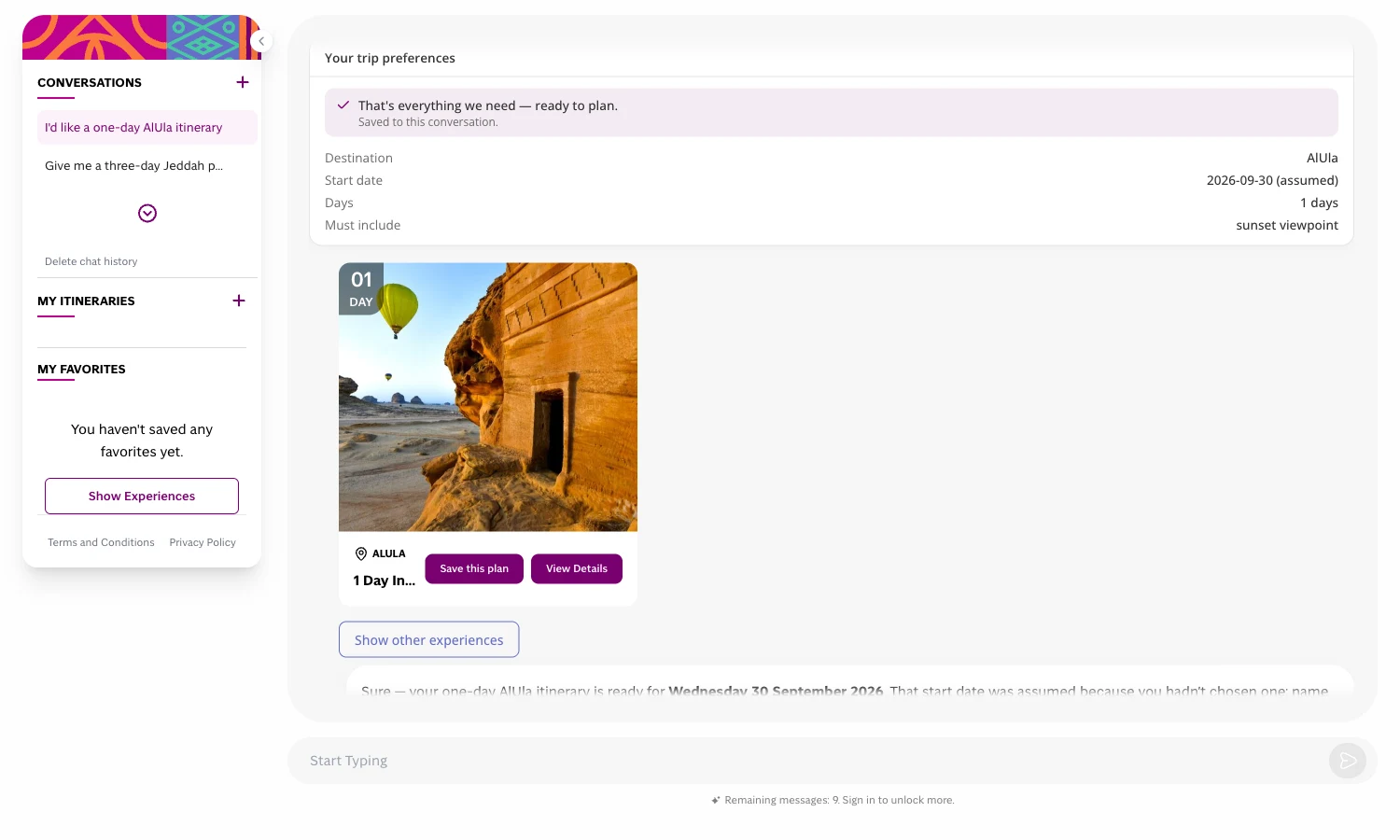
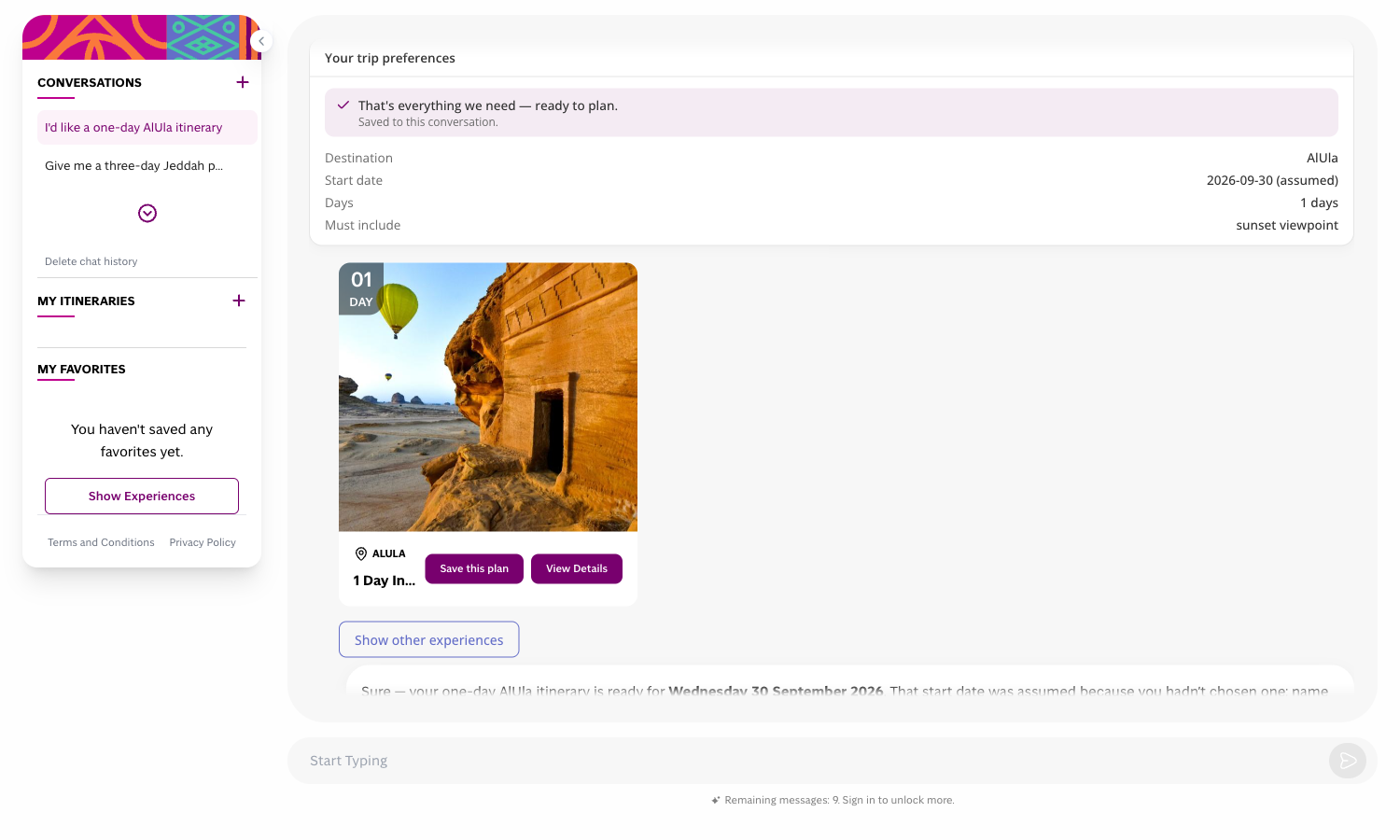
  • A one-day AlUla itinerary built by Noura
    A one-day AlUla itinerary built from the traveller's preferences, including the sunset viewpoint they asked for.
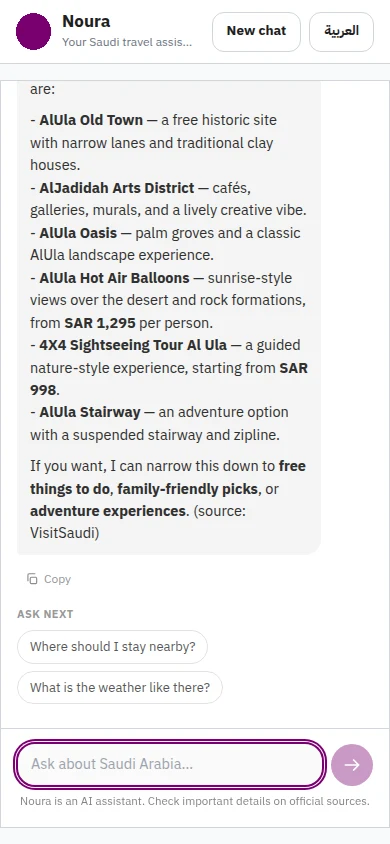
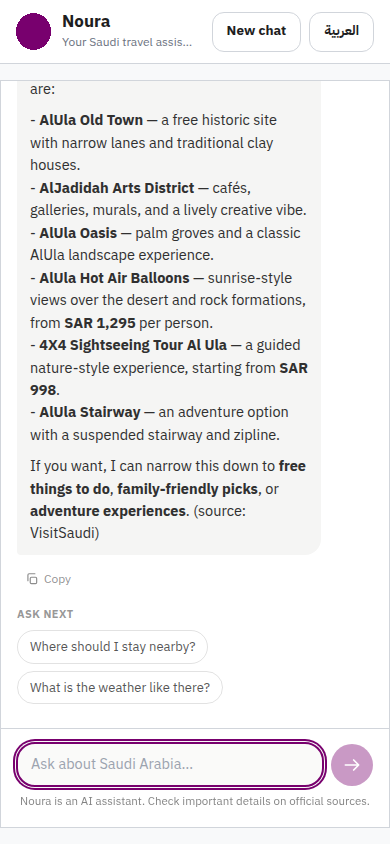
  • Noura on a phone
    Noura on a phone: the same answers and follow-up suggestions in a narrow layout.
The staff assistant

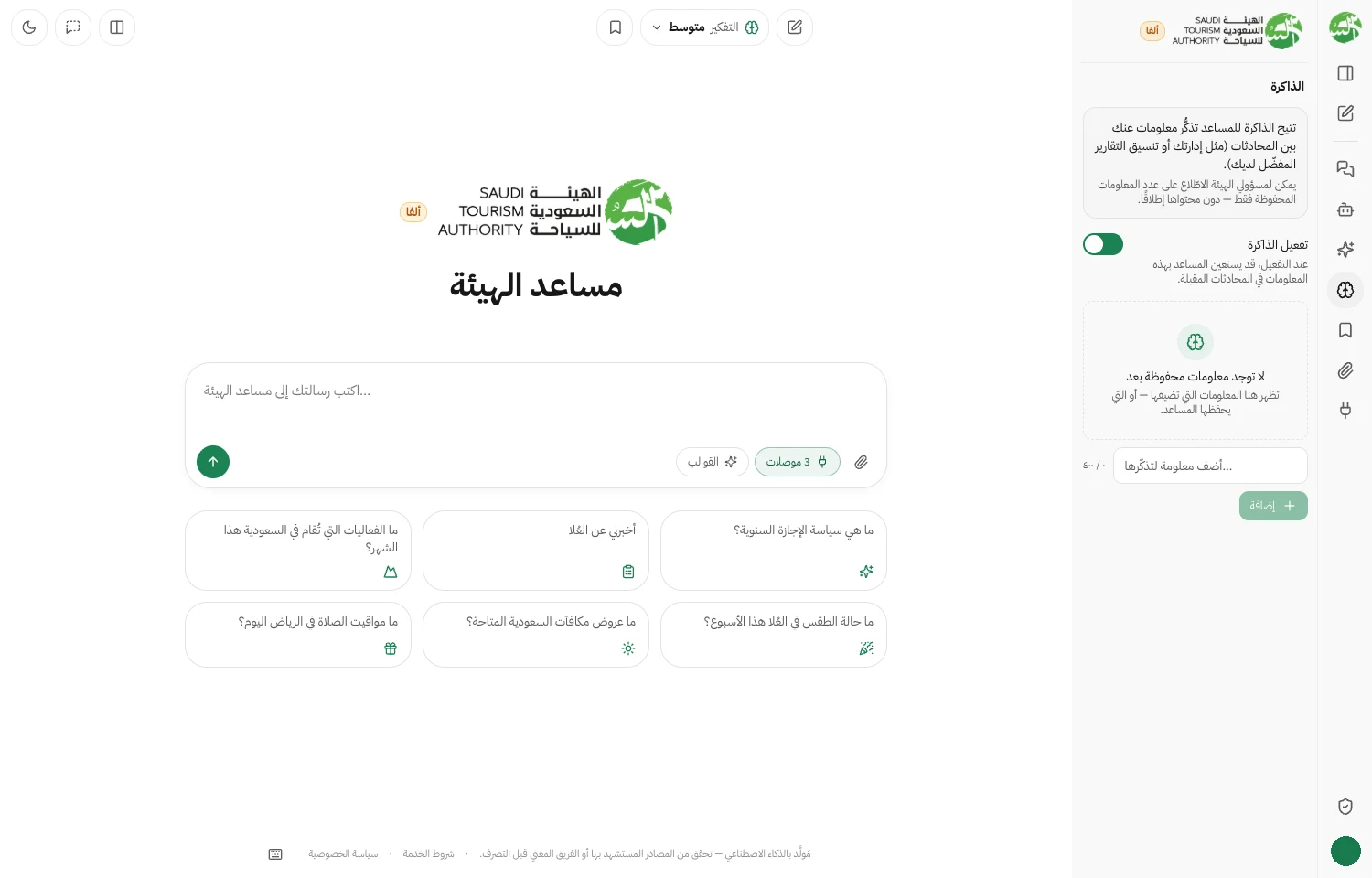
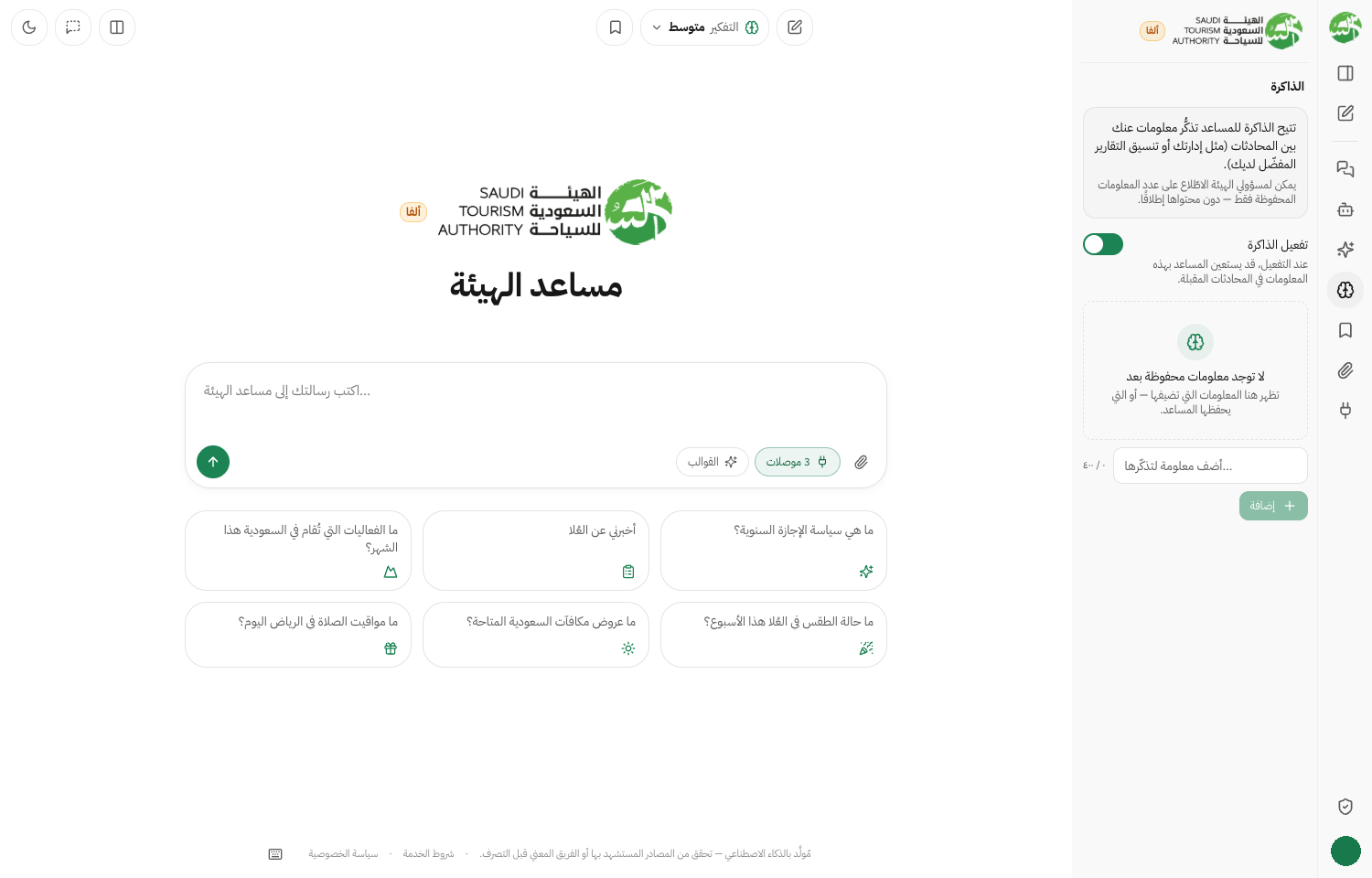
  • The staff assistant's home screen in Arabic
    The staff assistant's home screen in Arabic, with suggested questions and memory controls.
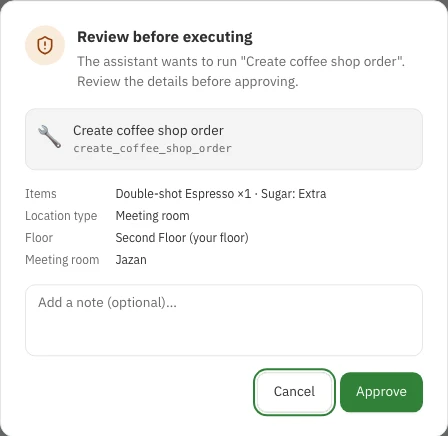
  • An approval request before a coffee order
    Human approval before any action: the assistant asks before placing a coffee order.
04

Architecture

Capability view: one LangGraph agent serves visitors and staff; an audience gate decides what each session may use, answers come from the authority's own content with their sources, and every action waits for a person's approval. Figure 1

Users and apps
  • Visitors (Noura)
  • Staff (staff assistant)
Orchestration
  • One LangGraph agent · 96 tools, 27 visible to visitors
Models
  • LLM
Retrieval
  • Retrieval with sources
Data
  • The authority's documents and tourism content
Services
  • Typed tools and cards · Destinations, events, visas, weather, trip plans, staff requests
Quality
  • Audience gate · Tools and knowledge per audience
  • Human approval · Before any action
  • Evaluation · Answer quality, retrieval
Connections
  • Visitors (Noura) to Audience gate
  • Staff (staff assistant) to Audience gate
  • Audience gate to One LangGraph agent (what each audience may use)
  • One LangGraph agent to LLM
  • One LangGraph agent to Typed tools and cards
  • Human approval to Typed tools and cards (before any action)
  • One LangGraph agent to Retrieval with sources
  • Retrieval with sources to The authority's documents and tourism content
  • Evaluation to One LangGraph agent
05

Outcome

  • One agent serves both Noura and the staff assistant, kept apart by the audience gate.
  • Noura was accepted in the client's user-acceptance testing (UAT) in September 2026.
  • Every action waits for the user's approval, and answers show their sources.
06

Stack

Orchestration
LangGraph
Retrieval
RAG
Services
PythonFastAPIReactTypeScript
Quality
LLM evaluation

Where these facts come from. Everything on this page comes from details I confirmed for this site. Nothing is estimated: where no figure is public, the page describes what the system does.

Keep reading

Questions about this build?

Ask my AI about “STA: Noura and the staff assistant”.

It answers from my CV and public profile, in English or Arabic.